


Hybrid meetings create a two-tier workplace in the UK, as half of Brits admit forgetting about their remote colleagues
Hybrid working may have become a permanent feature of working life in the UK, but meetings are failing to evolve alongside it.
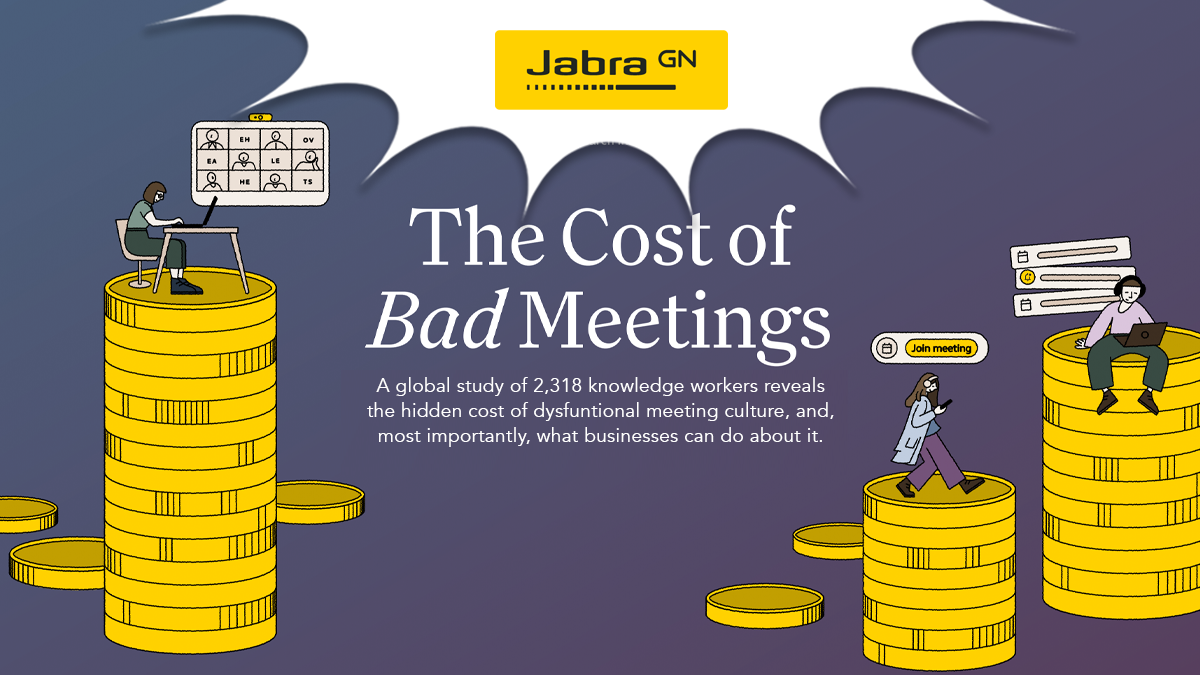
New research from Jabra reveals that poor meeting design and unreliable technology have created a two-tier workplace for UK and global businesses alike, with remote participants feeling excluded from discussions and left at a disadvantage compared with colleagues in the room. Research was conducted among 2,318 knowledge workers across the UK, US, Germany, France, Sweden, Denmark and India.
More than half forget
More than half (51%) of UK workers confess they forget to involve remote participants during meetings, while around half (55%) of remote attendees struggle to hear people in the room and 48% report difficulty identifying who is speaking.
Globally, the problem is even more pronounced; nearly half (46%) of knowledge workers around the world say they have felt “second-class”, talked over or left out during hybrid meetings. Similarly, 55% of hybrid participants say they feel excluded, compared with just 38% of people in fully remote meetings.
These findings point to a growing inequality gap in hybrid meetings, where remote employees are present yet not equally seen or heard. It is little surprise, therefore, that 86% of UK workers say they experience meeting dread, while 47% hit their meeting energy limit within just two hours.
The problem intensifies as organisations scale. Employees in large businesses (over 1,000 people) are almost twice as likely as those in SMEs (fewer than 250) to experience inconsistent meeting room technology (41% versus 23%), while remote workers in large companies more frequently feel “second-class” during meetings (55% versus 38%).
The business cost of the hybrid meeting
It is not only an inequality gap, but a purpose gap; globally, 66% of workers leave with unclear action items, while 59% need a follow-up meeting and generate additional work to recover from the confusion.
With these issues compounding, the cost goes beyond a negative experience and becomes a profitability drain. Jabra’s research estimates that the cost to UK businesses is a staggering £2.7 million a year for a company of 2,500. This is the equivalent of £1,079 per employee in lost time based on disruption rates for meetings against national salary data.*
“We’ve treated bad meetings as an irritation, not a financial risk,” commented Holger Reisinger, Senior Vice President Jabra Enterprise Video Business Unit. “If your people are dreading meetings, you’re already paying the price – and it’s a clear signal that organisations need to completely rethink and re envision their meeting culture, supported by technology that lets everyone be clearly seen and heard.”
AI meeting tools are being tested, not trusted
AI tools have the potential to improve meeting experience and outcomes, yet regular use remains low. In the UK, almost three in four workers (74%) have tried post-meeting AI summaries, but only a quarter (24%) use them regularly.
Similarly, 66% have tried live transcription, yet only 15% use it regularly.
Globally, accuracy and trust are the biggest barriers to wider adoption, cited by 42% of workers. Yet in the UK, privacy and compliance are bigger concerns, with 34% citing them as a barrier and one in five unsure whether they’re even allowed to use AI at work.
Room quality also affects confidence in AI outputs. Nearly two thirds of employees globally (62%) say they distrust AI-generated summaries when room audio quality is poor.
“AI can enhance a well-run meeting, but it can’t fix a broken one,” said Holger Reisinger. “If organisations want to unlock the value of AI in meetings, they need to start with the fundamentals, ensuring people can be clearly seen, heard and understood.”
Related Post: New Jabra PanaCast U30 is the Solution for BYOD Collaboration in Small Meeting Rooms
Related Post: New Jabra Bar and Kits for all Room Sizes
Related Post: Jabra welcomes Daniel Johansson
*Cost estimates are based on self-reported meeting time, disruption rates and follow-up activity benchmarked against national salary data.