


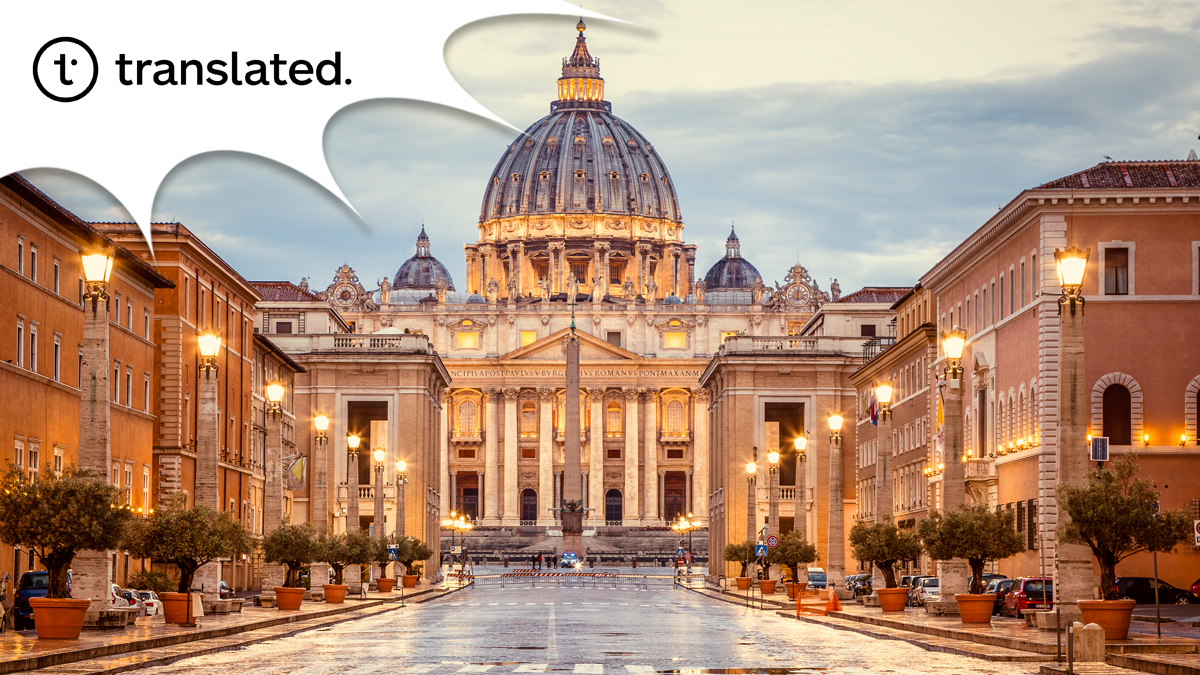
Translated, a Rome-based company combining AI with human linguistic expertise to transform real-time language translation, is bringing Lara, its AI-powered live translation system, to St. Peter’s Basilica. The system will allow attendees to follow the Holy Mass by Pope Leo XIV in 60 languages via their smartphones, with no app download or special equipment required.
Developed in collaboration with Translated and with scientific support from Professor Alexander Waibel, this initiative marks the first large-scale application of simultaneous AI interpretation within a sacred space at the Vatican. It aims to foster attentive participation and deeper understanding for the many faithful who gather at the Tomb of the Apostle.
The service will be rolled out during the main celebrations at St. Peter’s Basilica, with progressive implementation starting next week.
His Eminence Cardinal Mauro Gambetti, O.F.M. Conv., Archpriest of the Papal Basilica of Saint Peter in the Vatican, Vicar General of His Holiness for Vatican City and President of the Fabric of Saint Peter, stated:
“Saint Peter’s Basilica has, for centuries, welcomed the faithful from every nation and tongue. In making available a tool that helps many to understand the words of the liturgy, we wish to serve the mission that defines the centre of the Catholic Church, universal by its very vocation. I am very happy with the collaboration with Translated. In this centenary year, we look to the future with prudence and discernment, confident that human ingenuity, when guided by faith, may become an instrument of communion.”
Marco Trombetti, CEO and co-founder of Translated, remarked:
“Language enables meaningful encounters. Offering this service within Saint Peter’s Basilica is a concrete way to place artificial intelligence at the service of listening, participation, and understanding. We are honoured to contribute, with Lara, to an experience that helps people overcome linguistic barriers and feel truly included in the shared prayer of the Church.”
The launch coincides with the 400th anniversary of the Basilica’s dedication (1626–2026), bridging centuries of tradition with cutting-edge technology.