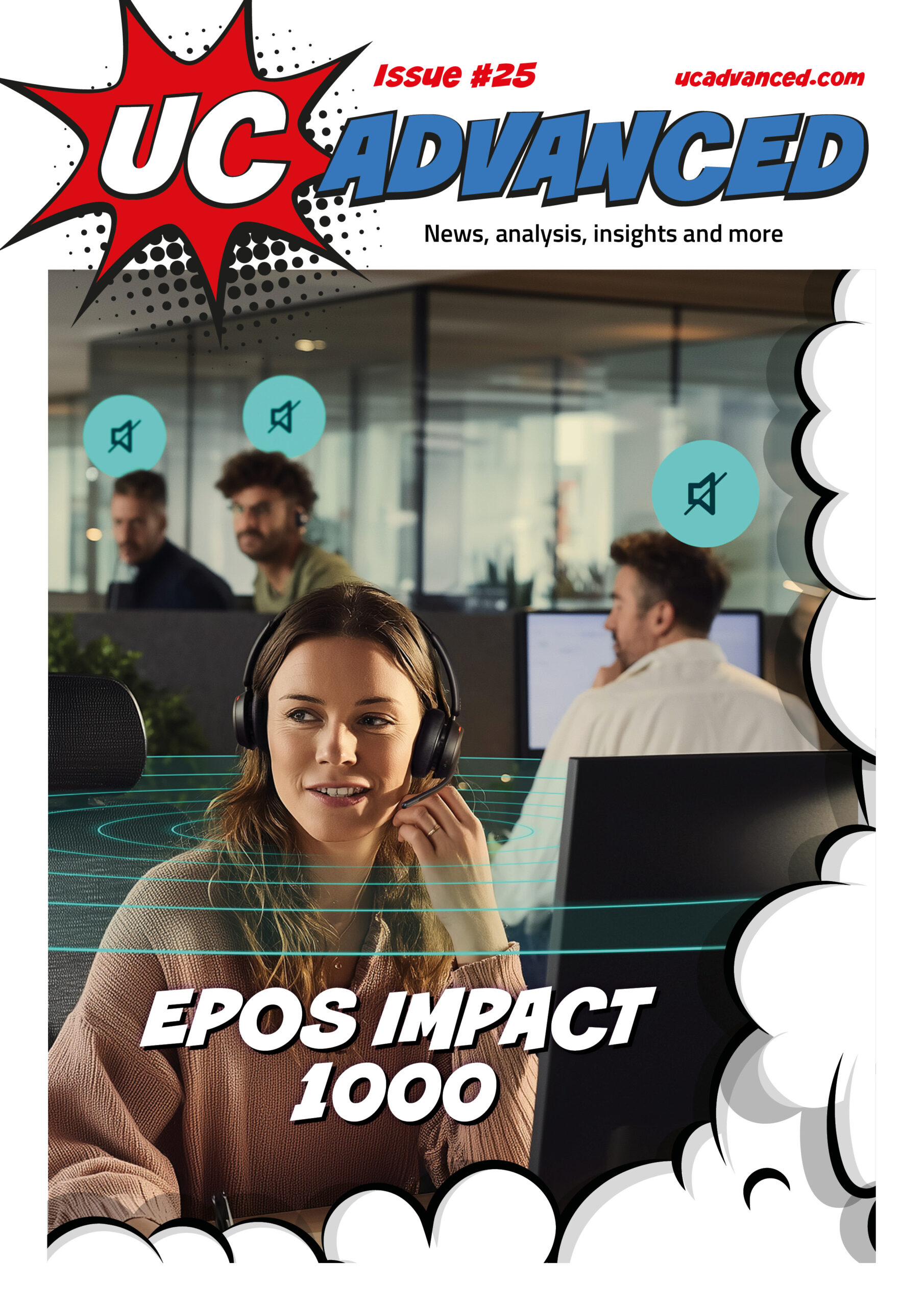




This article first appeared in UC Advanced issue #24.
Headsets are crucial for modern collaboration, helping employees navigate noisy environments by minimising distractions and ensuring clear communication. While purchasers prioritise microphone performance, manufacturers balance these needs with Active Noise Cancellation (ANC) features across various price points. Advanced hybrid ANC technologies reduce listening effort and improve cognitive performance without completely isolating users. Looking ahead, as conversational AI becomes mainstream, highly accurate microphones will be essential for seamless transcription and effective human-AI interaction.
One of the great myths of the return to the office movement after the pandemic is the idea that we were less productive at home than in an office.
Surveys at the time showed that people would work longer hours sitting at the kitchen table when there’s no train to catch, and colleagues can’t ‘just grab you for a minute,’ when you’re in a different postcode.
While they can’t solve the problem of irritating colleagues, headsets have become a vital part of the technology employees use, enabling them to participate in meetings and collaborate in almost any location.
“People working together inevitably creates more noise,” said Jessica Harrison, UK and Ireland Sales Director, EPOS. “With so much distraction around, and meeting spaces at a premium, headsets are playing an even more imperative role to not only block unwanted noise but make sure people are still heard and can collaborate effectively.”
Priorities
According to the EPOS survey, purchasers are prioritising headsets based on the ability to minimise distractions, along with the performance of the microphone.
That would give the impression that helping users get on with their work and being heard in meetings is more important than their listening experience, as ‘Active Noise Cancellation to keep focus’ and ‘Managing noise levels’ did not score highly in comparison.
If there is a split between how purchasers prioritise the experience for the person using the headset against the person they are talking to on a call, does this mean that the headsets are put together differently?
“Across our portfolio, there’s a balance,” said Richard Trestain, Product Marketing Manager, EMEA, Jabra. “Our Evolve 3 products are firmly focused on both parties. But perhaps further down the range, because you are creating a lower cost product, a mass market product that our customers would buy in the thousands to supply to the majority of their users. You could say, at that point, we reduce the music capability.”
Trestain continued, “We often don’t have ANC down that bottom end, although we do have a pretty good ANC range all the way down, and then there are things like corded headsets, which are great, but a little less convenient.
“I don’t think there’s a decision point in R&D where we ask who we’re benefiting more. It’s more about creating the right blend of features and benefits for the portfolio.”
Down the stack
Naturally, as prices decrease, there will be trade-offs for the quality of features. Although the effectiveness of active noise cancellation can be increased with a physical seal around the ear or ear canal, the ‘active’ part of the equation requires processing power and microphones, which cost money.
“ANC headphones or earbuds have microphones placed inside and outside the ear cups,” explains Harrison. “These microphones detect ambient sounds in real time. The captured sound is sent to a digital signal processor (DSP), which calculates a sound wave of equal amplitude but opposite phase to the detected noise.
“The headphones emit this anti-noise through the speakers. When the anti- noise meets the original sound, the two waves cancel each other out, reducing the perceived noise.”
For me, that sounds great. No distractions if I can’t hear anything. However, as Harrison continues, “Shutting people off from distraction is good, but with EPOS Hybrid ANC, they can still hear some background sound, as it’s very important not to block out everything and leave people feeling isolated and trapped from the outside world.
“They might need to hear a fire alarm being triggered or respond to a question being asked by a colleague, for example.”
Future of Headsets
According to EPOS, this hybrid adaptive ANC can reduce listening effort and improve speech recognition as well as memory recall!
“EPOS takes things to a whole new level with EPOS BrainAdapt,” continued Harrison, “a group of pioneering technologies that work together to improve cognitive performance by minimising the energy it takes the brain to process sound.
“Combining extensive research with smart algorithms, acoustic engineering and precision design, BrainAdapt encapsulates the ‘science of sound’ and identifies how we listen with our brain rather than our ears.”
EPOS say that BrainAdapt can help users become up to 40% more efficient. The goal of increasing efficiency is one they share with Jabra, as they focus on bringing improved voice pick up so AI can benefit, as well as humans.
“We firmly believe that conversational AI will be normal within three years,” said Trestain. I certainly use it, and I probably type 60% less than I did six months ago. I use tools like WhisprFlow to transcribe everything, and I’m talking to Copilot probably more than I’m talking to humans these days. That means the headset I’m using has to pick up what I’m saying accurately.
“I might as well stick with a keyboard if the AI is going to misunderstand or mishear me. If a human doesn’t understand perfectly, it’s embarrassing, and it’s annoying, but we can repeat ourselves. With AI, you have to go back and correct it, which is why advanced microphone capabilities are going to be necessary, which is where we’re really aiming.”