


Deutsche Telekom reimagines phone calls with AI embedded in the network
- Magenta AI Call Assistant: AI services embedded directly in the Telekom network
- App-free, devices-agnostic, directly accessible through a normal phone call
- Enables real-time translation, call summaries and contextual support
- Built in partnership with ElevenLabs
The MWC 2026 event is in full swing, this year held between 2 and 5 March in Barcelona, Spain, and it brings together many global exhibitors from the IT and Telecommunications sectors.
Yesterday, Deutsche Telekom chose the opportunity to unveil its Magenta AI Call Assistant. Deutsche Telekom AG, headquartered in Bonn, Germany, is Europe’s largest telecommunications company by revenue and a top-five global provider, with more than 273 million mobile customers, 24 million fixed-network lines, and 22 million broadband lines. The company operates worldwide, with a major footprint in the US via T-Mobile and throughout Europe, focusing on 5G, fiber-optic, and IT services.
Magenta AI Call Assistant
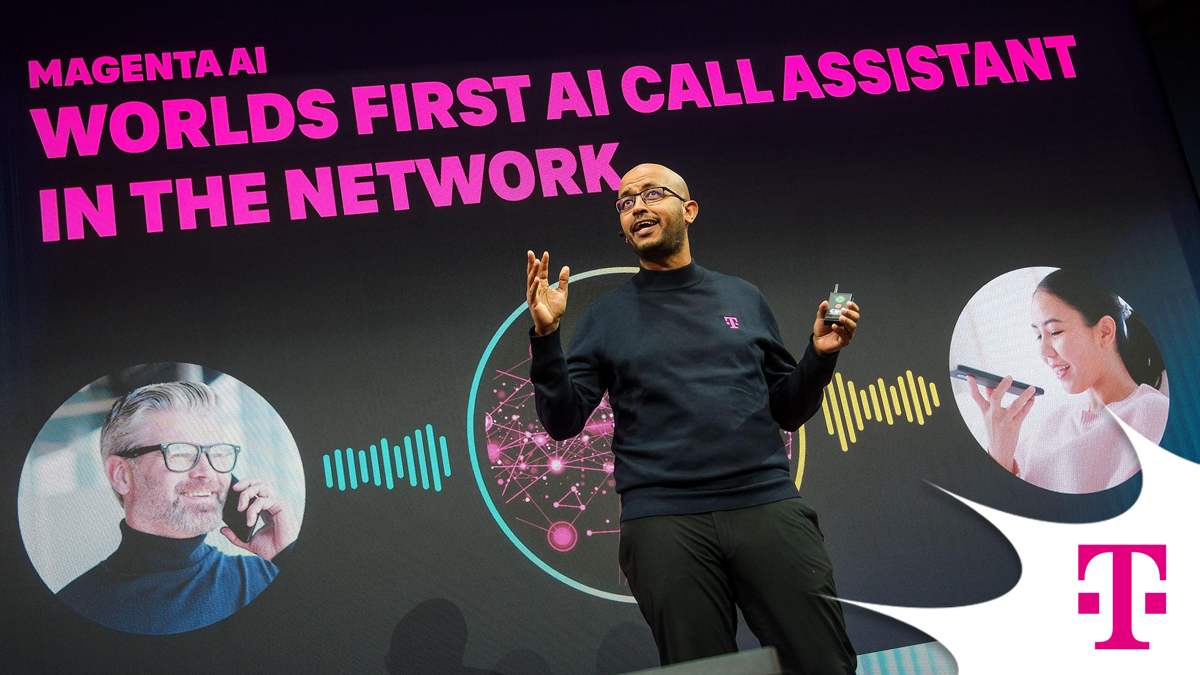
Built in partnership with ElevenLabs, the Magenta AI Call Assistant will enable an AI-supported phone call. Allegedly the smart call assistant which is Magenta AI becomes part of the phone call itself, available instantly in real time, without apps or premium hardware
Abdu Mudesir, Board Member, Product & Technology, at Deutsche Telekom, has stated:
“Our customers will get AI services like translation right in their calls. With our Magenta AI Call Assistant, we are the first in the world to offer these network based AI functions. We remove barriers — no apps, no special devices, no technical complexity. AI becomes simple, intuitive and available to everyone.”
Once activated during a call, the assistant provides real-time support. Initial features will include:
- Live translation across languages
- Conversation summaries to help the user retrieve important follow-ups
- Contextual assistance, such as answering questions or retrieving relevant information
“Hey Magenta”
The Call Assistant activates during a call with the words “Hey Magenta.” Once activated, it provides real-time support directly within the conversation. The assistant is designed for common situations in which people naturally seek help while speaking. Company spokesperson, Verena Fulde, in a recent blog, has put forward some examples of situations in which Magenta AI might be called upon:
- When friends are discussing where to meet, it can suggest nearby restaurants that fit both schedules and preferences.
- When planning a trip, it can compare travel options and make suggestions on what to discover – as a family with kids, couples, group of friends or individual travellers.
- When coordinating appointments, it can check availability and structure next steps.
- When language barriers arise, it translates in real time so each person can speak and listen in their own language.
If it becomes clear during a conversation that a reservation is necessary, the Magenta AI Call Assistant can make the booking (restaurant, doctor’s appointment, travel), fill out forms, ask questions (“What time suits you?”, “Window or aisle?”) and, at the end, neatly document the confirmation.
The Call Assistant processes spoken content only after the customer explicitly activates it during a call. Without activation, no conversation content is stored or analysed. Call participants are notified when the assistant is active, reflecting European data-protection standards.
Built in Partnership with ElevenLabs
Mati Staniszewski, co-founder and CEO of ElevenLabs, says:
“Together with [Deutsche] Telekom, we are redefining what a phone call can be. For the first time, AI agents will be embedded directly inside a call – translating languages, integrating context, and taking action in real time. With our AI agents and voice, and [Deutsche] Telekom’s network expertise, conversations will no longer be limited by language barriers or admin.”
The technical integration at the network level was carried out by Radisys.
Timings
The capabilities outlined above are set to arrive first for Deutsche Telekom customers in Germany starting sometime in 2026. Over the next 12 months, support for up to 50 languages is planned, with further services to follow.