


This article first appeared in UC Advanced magazine issue #25.
How is the AV industry addressing the challenges teachers face in the classroom?
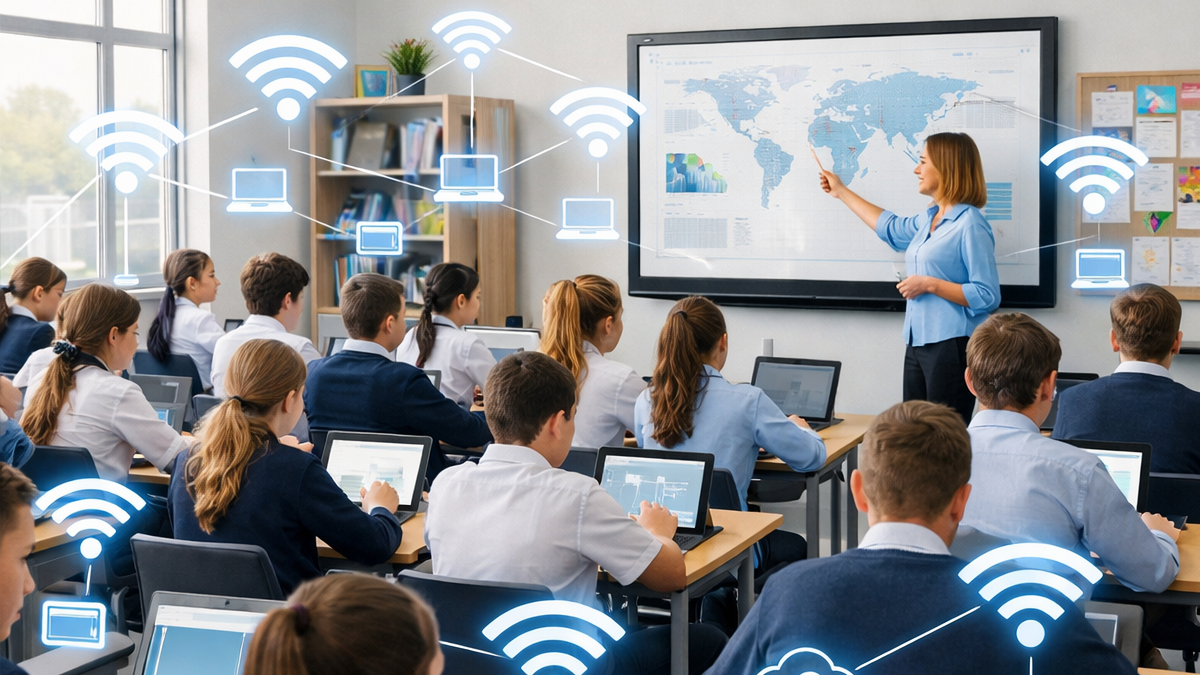
Modern educators face the growing challenge of shorter student attention spans, which increasingly demands highly engaging teaching methods. To adapt successfully, modern classroom audiovisual technology has shifted from fixed presentation tools toward flexible, interactive digital ecosystems. Devices like interactive displays and tablets empower students to participate in lessons and grant teachers greater mobility in the classroom. Although funding remains a significant hurdle, emerging technologies like artificial intelligence and immersive reality will continue transforming classrooms, provided they serve fundamental pedagogical needs first.
It must be challenging to be a teacher at the moment. As an outsider looking in, the impression that you get is that the youngest of us are unable to concentrate, obsessed with their phones, and only interested in the latest TikTok trends.
I’m sure a lot of that impression is rubbish, or at least exaggerated. Still, once you’ve got them to put their phone away and pay attention, the person at the front of the class has a job to prepare these kids for an employment market that will almost certainly be unrecognisable by the time they put together their first CV.
That’s not a challenge for the teachers to worry about for now. Their focus will naturally be on the lessons they compile in a world that seems to have accepted that long attention spans are a thing of the past.
According to research by Gloria Mark, PhD, at the University of California, it takes, on average, 47 seconds for someone to switch tasks. But while there is no conclusive evidence that younger people specifically are finding it harder to concentrate for long periods, Mark’s research raises a worrying generalisation that educators need to combat.
“Shorter attention spans are a reality for students, but AV technology can help when it’s used thoughtfully,” said Mandi Jackson, Education Director, Computeam.
“Over the last decade, classroom AV technology has shifted from simple presentation tools to platforms for interaction and inclusion. Where projectors were once the dominant tool, we’re now seeing a growing emphasis on interactive displays, integrated audio and seamless connectivity – all designed to support more engaging, collaborative teaching. Breaking lessons into varied, interactive segments, using multimedia purposefully and removing technical friction all help teachers maintain focus and momentum.”
Bringing an interactive element to the classroom is a key point, making sure that students take an active role in the learning process rather than maintain the same Victorian-style teaching of looking at one person at the front of the class.
“Over the last decade, classroom audio-visual technology has shifted from fixed, front-of-room hardware to more flexible digital ecosystems,” said Richard Anderton, Head of Education at Sync. “Where AV once largely meant projecting content from one device to one screen, schools now need technology that supports collaboration, mobility and different teaching styles.
“At Sync, we’ve seen more schools move towards Apple-led environments, where iPad, Mac and Apple TV work together seamlessly to make lessons more fluid, interactive and adaptable. The change is not just about sharper screens or better sound. It is about giving teachers the freedom to move around the classroom, share content quickly and make learning more inclusive for all.”
Investing in the Future
The education ed-tech market seems to be unanimous in the view that AV technologies can only be beneficial to the education of young people.
You’d find the same opinion from a lot of teachers out there, too. However, giving them access to these technologies requires money.
Research from Epson shows that over three-quarters of teachers across Europe say immersive technologies are rarely or never used in their schools, and 57% of teachers in the UK would like their schools to increase the use of immersive learning or introduce it in the first place!
While we would be hard-pressed to find a school without some form of AV technology in the classroom, whether it is good enough is a different debate altogether.
“Projectors and interactive whiteboards played an important role in digitising classrooms, making lessons more visual and allowing teachers to annotate, demonstrate and explain concepts more clearly,” said Anderton.
“However, they are often built around a teacher-led model, with most interaction happening at the front of the room. Schools are now looking for tools, such as an iPad, that allow pupils to contribute more actively.
“That means moving towards systems where work can be shared from multiple devices, discussions can happen in real time, and pupils are part of the lesson rather than simply watching it.”
According to the research from Epson, 85% of teachers want more “freedom to roam” around the classroom while teaching, and 71% believing greater teacher mobility would improve student engagement.
“Not only are flat-panel touchscreen displays smaller and less engaging, but they’re also holding some students back,” said Graeme Davidson at Epson Europe.
“Using modern, bright projectors with large displays and remote control via an app, teachers can become free within the classroom”.
Not a Competition
Whilst the debate of projection against panels will rumble on, the point about ensuring the lesson sinks in with the pupils has to be the priority when deciding what to go for.
Jackson said that the conversation around Ed Tech shouldn’t be about replacing what’s already there. She would rather the technologies be used together.
“Projectors and interactive whiteboards both still have a place. Projectors can work well in larger spaces or where budgets are tight, but interactive whiteboards enable far richer participation.
“They allow teachers and pupils to engage directly with content, adapt lessons in real time and cater to different learning styles. It’s less about one technology replacing another, and more about choosing the right tool for the right teaching context.”
“Technology works best when it helps teachers vary the pace and format of a lesson,” added Anderton. “Shorter attention spans do not mean pupils cannot engage deeply, but they do respond well to lessons that feel active, visual and responsive.
“AV can support that by allowing teachers to move quickly between video, live annotation, pupil work, quizzes and discussion.
“The key is reducing friction and providing a more engaging, flexible lesson plan for teachers. If the technology is easy to use, teachers can focus on teaching, questioning and adapting the lesson, rather than managing equipment.”
Immersive Learning
If the order of the day is for more engaging lessons, then artificial intelligence surely provides a great opportunity to help teachers in the classroom.
On top of the ability to create almost anything from a small prompt, Anderton said that AI will also help figure out what is working and what isn’t.
“AI, immersive content and classroom analytics are all likely to shape the next phase of education technology. AI has clear potential to support planning, feedback and personalised learning, while immersive tools can help pupils explore complex topics in more visual and memorable ways.
“Devices such as MacBook Neo represent a shift towards more accessible Apple technology for education, giving schools an affordable way to engage with the same premium device ecosystem used across higher education and the workplace.
While the technology may be becoming more accessible, Jackson warned that educators need to maintain a focus on education.
“Looking ahead, emerging technologies such as AI‑enhanced AV, immersive AR and VR, and hybrid‑first classroom design will continue to shape education.
“The real challenge – and opportunity – for school leaders is ensuring technology serves pedagogy, not the other way around.”