


What role will communications play in the AI era?
That was the question underpinning discussions at Avaya Journeys UK, where speakers explored how organisations can connect AI with enterprise data and customer interactions through their communications environments to deliver what Avaya describes as “connected actions”.
“Journeys with Avaya” London 2026 took place on 17 July 2026 at the Shangri-La The Shard, London, bringing together customers and partners to showcase Avaya Infinity, Avaya Nexus and the company’s AI-powered customer experience strategy.
A recurring theme was that enterprise AI delivers greater value when it is embedded within business processes and can draw on organisational data, business knowledge and customer interactions, rather than operating as a standalone application.
David Funck, Chief Technology Officer at Avaya, argued that this shift requires platforms capable of orchestrating AI across communications, enterprise systems and customer journeys while remaining open to multiple AI models as technologies evolve.
MCP Support
The event covered Avaya’s support for the Model Context Protocol (MCP), with the company announcing it is the first Contact Centre as a Service provider to support the emerging open standard. Funck explained that MCP enables large language models (LLMs) to securely obtain context, understand what is happening across enterprise environments and interact with operational business systems. As an example of this approach, Avaya Infinity was presented as a platform that brings together digital channels, voice, AI and enterprise systems to support what the company describes as “connected actions”.
The presentations emphasised that AI makes resilient communications infrastructure even more important.
Organisations operating in healthcare, financial services, government, utilities and other regulated sectors still require highly available, secure communications regardless of how AI is deployed.
Funck used Avaya Nexus, the company’s mission-critical communications platform, to illustrate how those requirements can be addressed through continuous availability, strong security and flexible deployment across on-premises, hybrid and cloud environments.
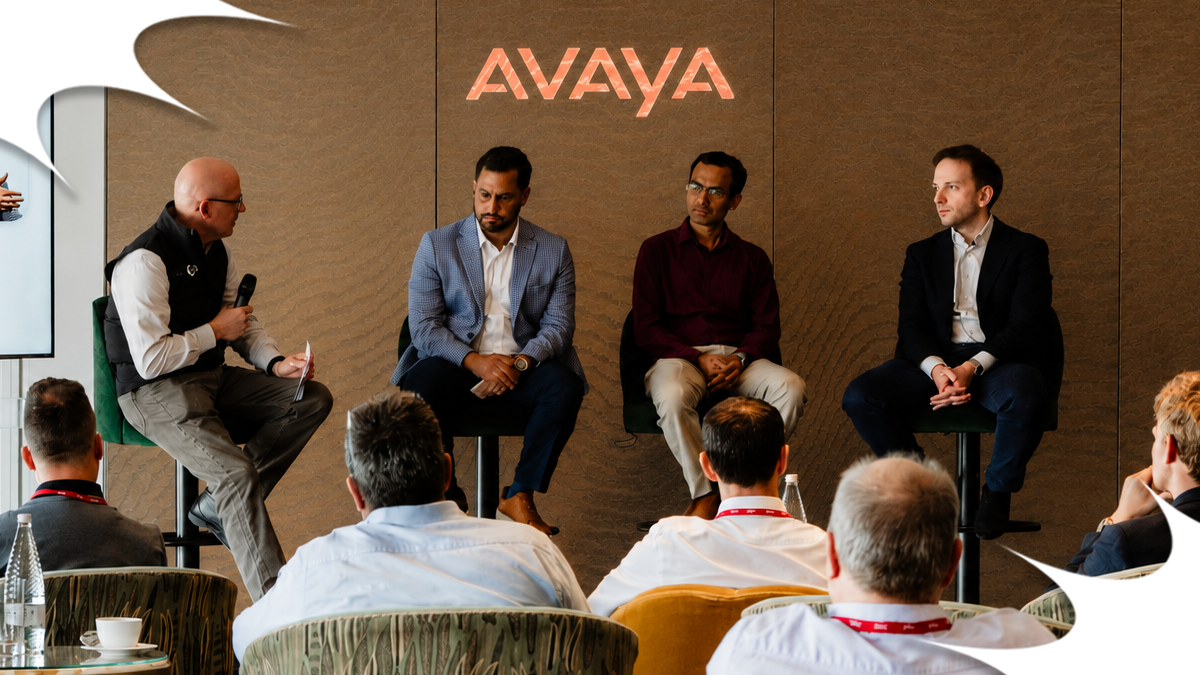
The event’s alliance panel broadened the discussion beyond technology platforms to the governance challenges surrounding enterprise AI. Avaya partners and speakers from Databricks, PolyAI and OneMeta explored how organisations are balancing rapid AI innovation with growing requirements for data sovereignty, regulatory compliance and enterprise control, highlighting the importance of retaining governance over sensitive business information while remaining flexible in how AI technologies are deployed.
The panel also examined the emergence of agentic AI capable of completing business tasks rather than simply responding to requests.
Panellists argued that decisions around autonomous AI increasingly depend on the confidence and risk associated with individual business processes, with higher-risk scenarios continuing to require human oversight.
The discussion also covered Avaya’s Tandem Care model, where AI and human agents work together to preserve context and support smoother handovers when human judgement or empathy is required. Speakers added that organisations should balance AI-driven efficiency with workforce wellbeing, ensuring technology supports rather than overwhelms employees.
Avaya Journey UK Panel Conclusion
The panel concluded that successful enterprise AI will depend less on the sophistication of AI models, which are becoming increasingly commoditised, and more on the trust organisations place in them. Building that trust requires reliable data, effective governance, measurable outcomes and a measured approach to deployment, while ensuring human wellbeing remains central to AI-enabled workflows.
Related Post: Cardiff Schools Embrace Avaya Cloud Office for PSTN Switch-Off Transition