


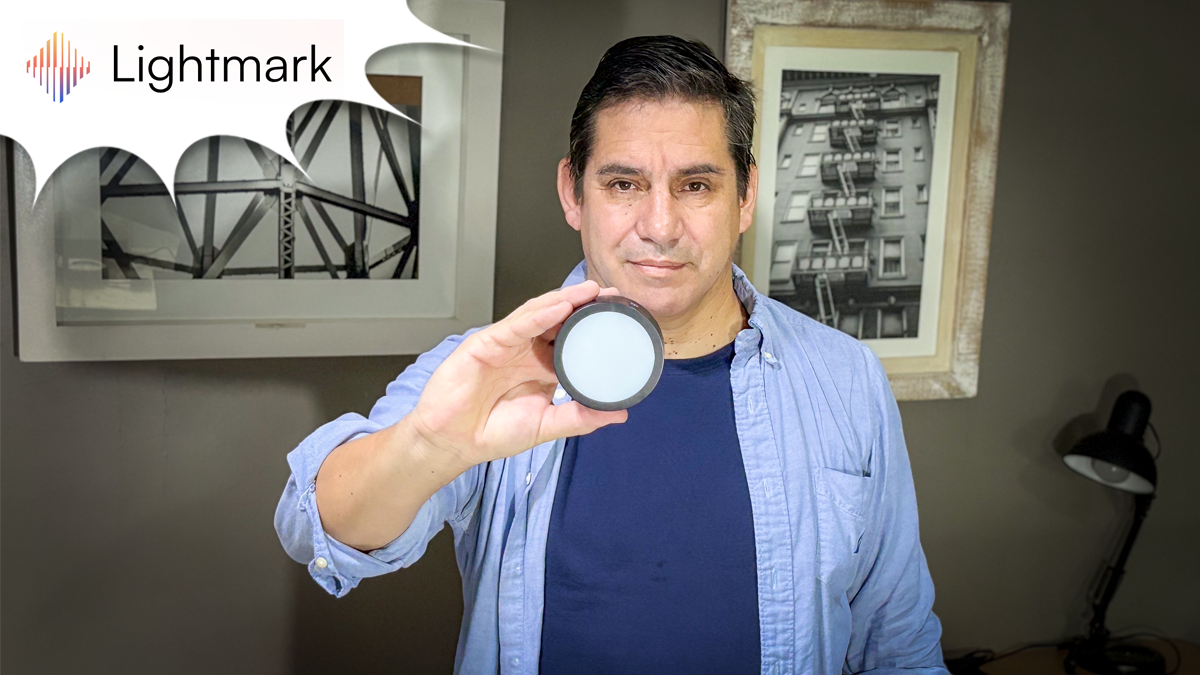
Pictured: founder and inventor Daniel Oblitas Garafulic.
Lightmark, a UK-based tech company, today launches technology that turns ordinary light at the moment of capture into an unforgeable proof of origin, enabling secure authentication and tracing of video.
A new UK technology adds an unforgeable and invisible “fingerprint of light” to regular light sources inside the room as a video is being recorded, making it possible to prove, beyond doubt, where and when that footage was captured.
Fake video is now a multi-million-pound problem. The May 2024 Tyson Fury vs Oleksandr Usyk boxing match lost an estimated £100M+ to live-stream piracy in a single night. The rapid advance of generative AI is compounding the threat, with today’s deepfakes fooling human viewers three times out of four. The war in Ukraine highlighted how the same vulnerability reaches journalism and national security: contested footage has undermined frontline reporting and repeatedly stalled intelligence operations and war crimes prosecutions.
Today’s tools, including metadata standards (C2PA), AI detectors, and watermarking, all try to verify content after it has been made. Lightmark proves authenticity from the moment of capture. The technology adjusts the lighting in a room, invisibly to anyone in it, so every camera that films picks up a unique signal automatically, even in smartphone recordings. Software can later read the signal to confirm exactly where and when the footage was recorded. The fingerprint cannot be added after the fact, or stripped by filters or compression, or fabricated by AI.
In a sports arena, every camera becomes part of a tamper-proof record of the event. The Bundesliga reports detecting roughly 10,000 illegal streams every matchday; pre-capture authentication traces each pirated copy back to where it leaked from, with evidence that holds up legally. In a war zone, footage of attacks or troop movements becomes evidence the International Criminal Court can act on. Prosecutors investigating Ukraine have repeatedly hit walls trying to prove what is real.
Founder and inventor Daniel Oblitas Garafulic, states:
“I am certain we’ve got a real working solution to one of the biggest issues in the age of digital communication and media. We can now create a space where video footage can be trusted beyond any doubt. I hope it can be part of creating a more reliable and transparent digital world.”
Real world Applications
Use cases span live-broadcast piracy, defence and intelligence, public-sector authenticity, and major-studio IP protection, four sectors facing rising deepfake exposure ahead of the EU AI Act’s 2 August 2026 transparency deadline.
Validated and patented
Complementary research published at SIGGRAPH 2025 by Cornell University validated the core physics behind light-based video authentication. Lightmark is the first to turn that science into a commercial product. The technology is protected by a UK patent application filed in May 2025 covering 15 core claims, with international PCT filings in flight.
“The problem today is that we try to determine the truth after the fact. We start at the moment the content is created,” says Oblitas Garafulic.
High Praise and Endorsement for Lightmark’s technology
Three people who are endorsing and supporting the new technology are
- Mario Aguilar de Irmay, Senior Portfolio Strategist, Janus Henderson Investors, who says, “Lightmark encodes authenticity at the point of creation. Every viewer downstream is making a more informed decision.”
- Andres Brockmann, CEO & Founder, AquaLitos, who comments “Lightmark will change how we see the world, free from AI concerns and piracy, protected at the origin.”
- Randy Thompson, CEO, Valhalla Capital, can also see the potential, and states, “Lightmark’s technology is comparable to fingerprinting or Carbon 14.”
UC Advanced expects the technology is applicable to more use cases than first imagined.